
In short
- Stainless steel is the all-rounder for browning, sauces and the oven; cast iron is for searing and long, even heat; nonstick is for eggs, pancakes and delicate fish.
- A PTFE nonstick coating is not a health risk when used as intended, according to Germany’s risk assessors; the danger is heating it empty, which can reach the 360 °C at which it breaks down.
- Bits of a scratched coating that end up in food pass through the body unchanged; replace a worn pan because it no longer works, not because the flakes are toxic.
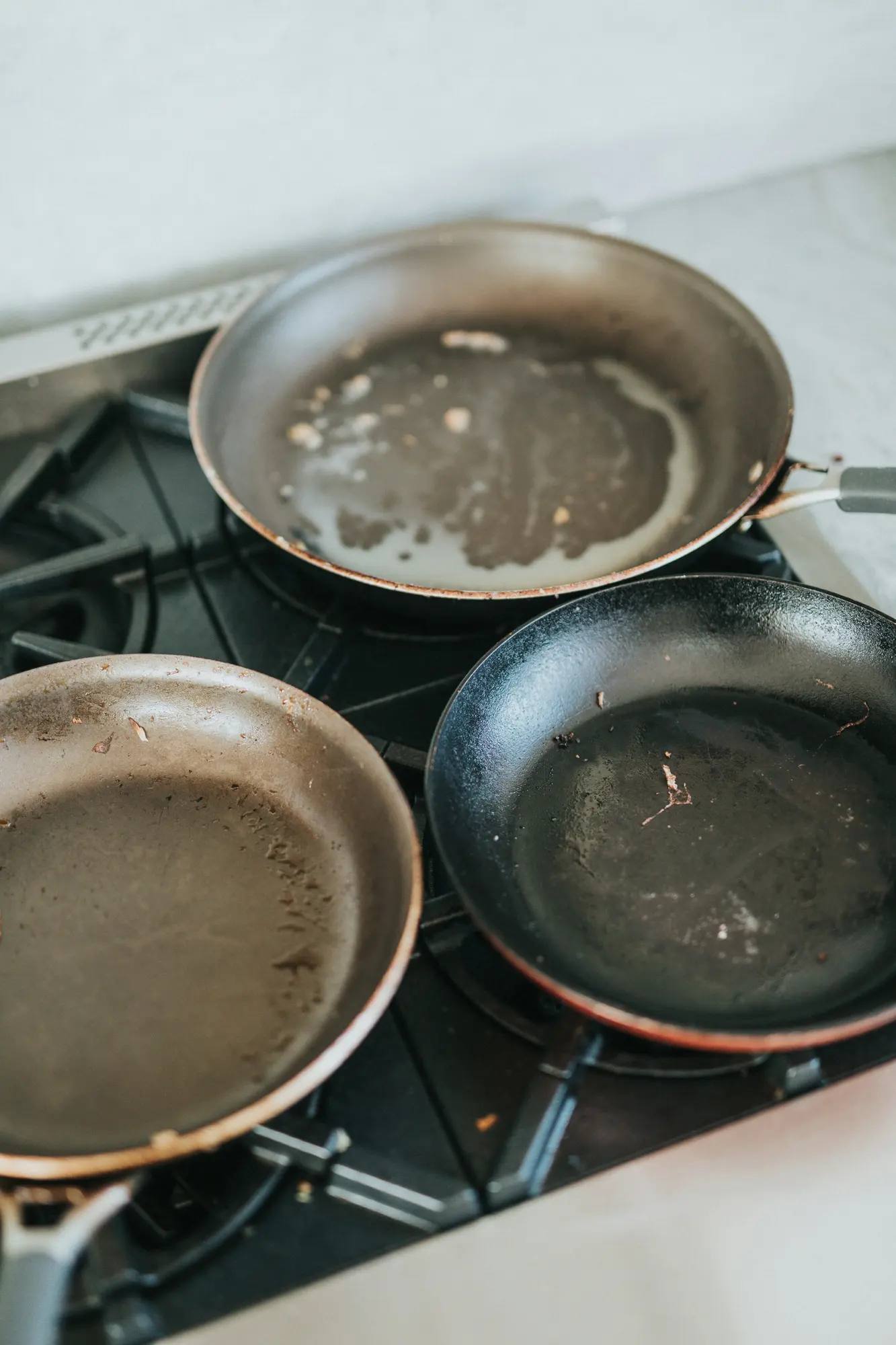
Most kitchens need two pans, not ten. The useful question is not which material is best, but which jobs you cook most. A frying pan that browns a chop properly is not the one that slides an omelette onto a plate, and a pan that sears a steak at full heat is not the one to leave tomato sauce in overnight.
What each pan is made of
Stainless steel is an alloy of iron with chromium and nickel. The grades used for food, usually 304 and 316, are chosen because they resist corrosion1. On its own steel spreads heat poorly, so good pans sandwich a layer of aluminium or copper inside the steel (labelled clad, tri-ply or multi-ply) or bond a thick disc to the base.
Cast iron is iron with a little carbon, cast thick. It heats slowly and unevenly at first, then holds that heat stubbornly. Its cooking surface is not bare metal but seasoning: oil baked on until it turns into a hard, slick layer2.
Nonstick usually means a coating of PTFE (polytetrafluoroethylene, best known under the brand name Teflon) bonded onto an aluminium or steel body. PTFE has a slightly waxy surface that water and fat do not wet, which is why food releases from it3. A second family, often sold as ceramic, uses a coating made by a sol-gel process; GreenPan, for example, describes its Thermolon coating this way and says it contains no PFAS4.
The comparison
| Stainless steel | Cast iron | PTFE nonstick | |
|---|---|---|---|
| Best at | Browning, pan sauces, oven finishing | Searing, shallow frying, baking | Eggs, pancakes, delicate fish |
| Heat it up | Medium heat, then add fat | Slowly, then it stays hot | Low to medium, never empty |
| Acidic food | Fine for cooking, do not store | Short cooking only | Fine |
| Metal utensils | Yes | Yes | No, they scratch the coating |
| Dishwasher | Usually yes | No | Check the maker |
| Induction | If the base is magnetic | Yes | If the base is magnetic |
| Lifespan | Decades | Generations | A few years of daily use |
The induction row comes down to magnetism: induction hobs only heat pans made of, or with a base of, ferrous (magnetic) metal, and a magnet test on the base tells you in a second5.
What the evidence says about nonstick
This is where most of the fear lives, so it is worth being exact.
The German Federal Institute for Risk Assessment (BfR) is clear that PTFE cookware used as intended is not expected to harm health. The risk appears only when the coating is strongly heated while the pan is empty: from about 360 °C PTFE starts to decompose and releases gases that are hazardous, without visible smoke3. As long as there is food with water in the pan, the temperature cannot climb much above 100 °C, and oils start to smoke somewhere between 110 and 270 °C, which acts as a warning3. The practical rule follows directly: never preheat a nonstick pan empty, and be careful on induction and gas, which heat very fast3.
The other worry is the idea that a scratched pan sheds chemicals into your food. The BfR addresses this directly: tiny particles from a damaged coating are not expected to affect health if swallowed, because PTFE is inert and the particles pass through the body unchanged3. The US Food and Drug Administration reaches a similar view from another angle: nonstick coatings are polymerised and bound to the pan by heat, and studies show only negligible amounts of PFAS in the coating can migrate to food6.
Two honest caveats remain. First, PTFE belongs to the very large chemical family called PFAS, many of which persist in the environment; the problem is mostly in how they are made and disposed of, and the European Food Safety Authority notes that the contribution of food contact materials to our exposure is small compared with food and water themselves7. Second, a worn pan does stop working: food sticks, you add more fat and turn up the heat. That is the real reason to replace it. We go through the chemistry in detail in a later article on PTFE, PFOA and PFAS.
What the evidence says about steel and iron
Stainless steel is not perfectly inert either. In a 2013 study, researchers cooked tomato sauce for up to 20 hours in stainless steel and measured the metals that moved into it. Nickel and chromium both rose. The amounts fell over the first uses of a new pan and levelled off after about six cooking cycles, but stayed well above sauce cooked without steel, and the steel grade made a difference1. The authors point out that nickel can trigger dermatitis in people already sensitised to it1. For most people this is not a reason to avoid stainless steel; for someone with a nickel allergy, it is a reason to cook long acidic dishes in enamelled cast iron or glass, and never to store them in the steel pan.
Cast iron moves iron into food, and here the effect is usually welcome. A 2021 systematic review of 13 studies found that cooking in iron pots or with iron ingots increased the iron content of food, and four studies reported significant rises in blood haemoglobin, with smaller changes in the others8. It is a useful side effect where iron deficiency is common, not a reason to cook everything in iron.
How to choose your first two pans
If you cook a bit of everything, start with a 28 cm stainless steel frying pan with a clad body and a 24 cm nonstick pan reserved for eggs and fish. The steel pan does the browning, the deglazing and the trips into the oven; the nonstick pan does the gentle jobs at gentle heat, and lasts longer because it never sees high heat.
If you love searing, shallow frying and cornbread, swap the steel pan for a 26 cm cast iron skillet. It is heavier and needs drying and a wipe of oil after washing, but it will outlive you2.
If someone in the house has a nickel allergy, favour cast iron, enamelled cast iron and a good nonstick pan, and keep stainless steel for quick cooking.
If you are on induction, take a magnet shopping5.
Habits that make any pan last
- Heat stainless steel and cast iron before adding fat, and add food when the fat shimmers. Most sticking comes from adding food to a pan that is not hot enough yet.
- Keep nonstick at low to medium heat, always with something in it, and use wooden or silicone tools.
- Let any pan cool before washing; a hot pan plunged into cold water can warp.
- Dry cast iron straight away and wipe it with a thin film of oil2.
- Do not store acidic food in steel or iron; move leftovers into glass.
The best pan is the one that suits the job in front of you. Two well-chosen pans, used for what they are good at, will do more for your cooking than a matching set of ten.
Questions
If my nonstick pan is scratched, do I eat chemicals?
Germany’s Federal Institute for Risk Assessment says that tiny particles from a scratched PTFE coating are not expected to harm health if swallowed, because PTFE is inert and passes through the body unchanged. The real risk with PTFE is overheating an empty pan.
Does stainless steel release metals into food?
A little. A 2013 study found nickel and chromium in tomato sauce cooked for hours in stainless steel, with the most from a new pan and a lower, steady amount after about six uses. It matters mainly for people with a nickel allergy, who can avoid long acidic simmers in stainless.
Does cooking in cast iron add iron to food?
Yes. A 2021 systematic review found that cooking in iron pots raised the iron content of food, and some studies saw small rises in haemoglobin. Useful if you are short of iron; not a reason to cook everything in it.
Which pans work on induction?
Pans with a magnetic base. Cast iron always works; many stainless steel pans do; aluminium nonstick pans work only if they have a magnetic plate in the base. A fridge magnet that sticks firmly to the base is the quick test.
Sources
Numbered in the order the article cites them. Opened and read on the date shown.
- Stainless steel leaches nickel and chromium into foods during cooking (J Agric Food Chem 2013;61(39):9495-9501) Kamerud KL, Hobbie KA, Anderson KA, 2013. Read Thursday, 22 October 2026.
- Beginner's guide to cast iron Lodge Cast Iron (manufacturer). Read Thursday, 22 October 2026.
- Selected questions and answers on cookware, ovenware and frying pans with a non-stick coating made of PTFE German Federal Institute for Risk Assessment (BfR), 2025-07-02. Read Thursday, 22 October 2026.
- Thermolon: our healthy ceramic non-stick coating GreenPan (manufacturer). Read Thursday, 22 October 2026.
- Induction compatible cookware: how to tell Whirlpool (manufacturer). Read Thursday, 22 October 2026.
- Questions and answers on PFAS in food U.S. Food and Drug Administration. Read Thursday, 22 October 2026.
- Per- and polyfluoroalkyl substances (PFAS) European Food Safety Authority (EFSA). Read Thursday, 22 October 2026.
- Effect of cooking food in iron-containing cookware on increase in blood hemoglobin level and iron content of the food: a systematic review (Nepal J Epidemiol 2021;11(2):994-1005) Sharma S, Khandelwal R, Yadav K, Ramaswamy G, Vohra K, 2021. Read Thursday, 22 October 2026.
How we write and check: our method. Spotted an error? Tell the editor.