In short
- Air fryers excel at food that should be crisp outside: potatoes, vegetables, chicken thighs and wings, fish fillets, frozen snacks and leftovers that need reviving.
- They struggle with wet batters, loose leafy food, big joints of meat and anything that needs liquid to cook, such as raw rice or pasta.
- Use time as a guide and a thermometer as the answer: 74 °C in the thickest part for poultry, 63 °C plus a short rest for steaks, chops and fish.
An air fryer works by blowing very hot air around food at high speed. That moving air strips moisture from the surface and browns it quickly, which is wonderful for some foods and wrong for others. Once you see it as a small, fierce fan oven, the rule of thumb is easy: if you would happily cook it on a tray at the top of a hot fan oven, it will probably do well in an air fryer, and faster.
What it does brilliantly
Potatoes, in almost every form. Chips, wedges, roast potatoes, sautéed cubes, reheated leftovers. Dry them well, toss with a teaspoon or two of oil and some salt, cook in a single layer and shake the basket halfway.
Roasting vegetables. Broccoli and cauliflower florets, peppers, courgettes, carrots, Brussels sprouts, onion wedges, chickpeas. They brown at the edges in a fraction of the oven time.
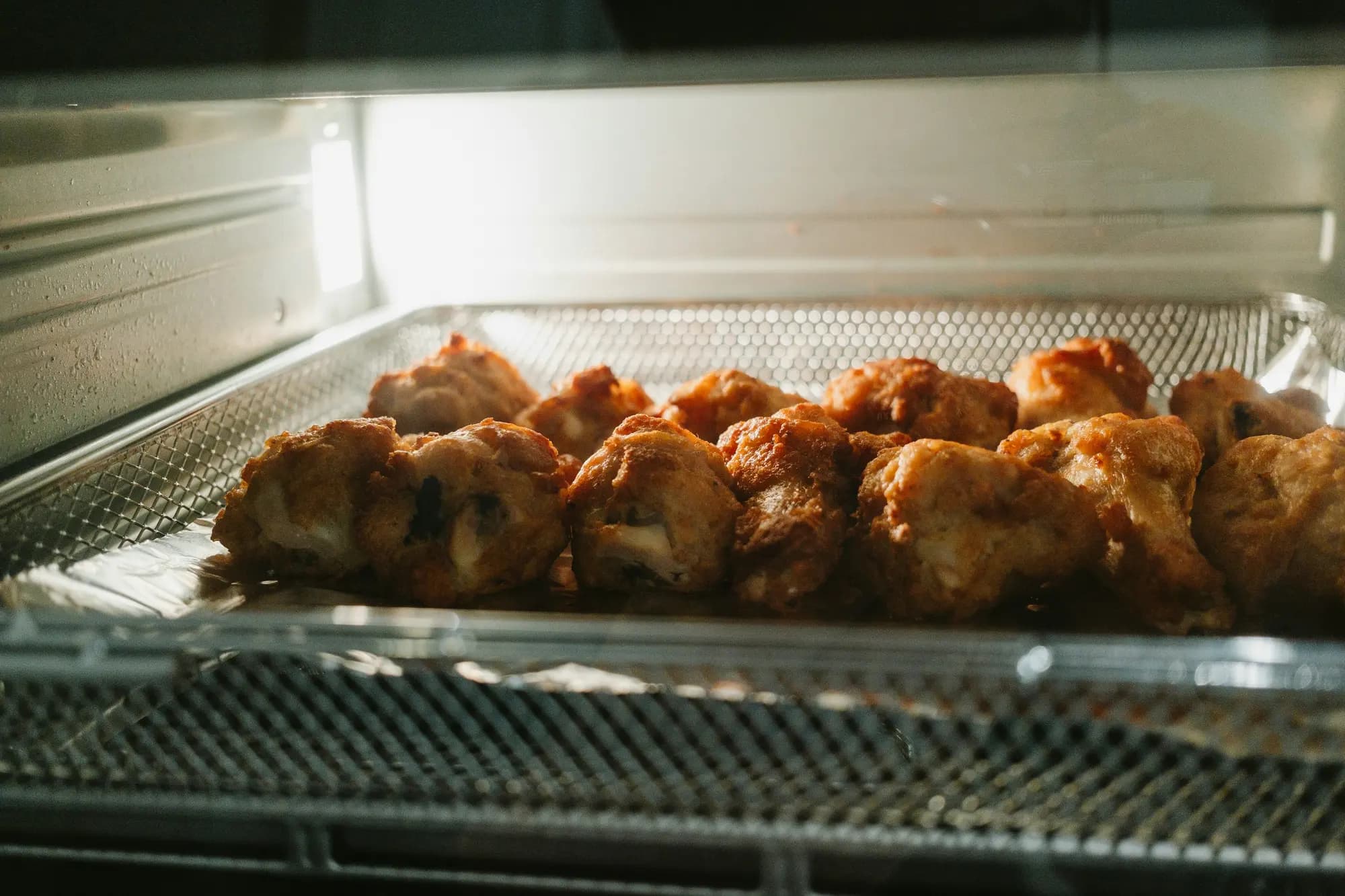
Chicken thighs, drumsticks and wings. The fat under the skin renders and the skin crisps. Breasts work too, but dry out more easily, so a thermometer matters even more.
Fish fillets and prawns. Salmon, cod and other firm fillets cook quickly and evenly. Breaded fish works well with a light spray or brush of oil.
Frozen convenience food. Chips, fish fingers, nuggets, spring rolls and the like are designed to crisp in a fan oven, and an air fryer is a fan oven with a shorter distance between heat and food.
Reviving leftovers. Pizza, roast potatoes, fried chicken and pastries come back crisp instead of rubbery, which a microwave cannot do.
Small jobs. Toasting nuts and seeds, crisping tofu, halloumi or bread for croutons, cooking a couple of sausages without heating the whole oven.
What it does badly
- Wet batters. A liquid batter like tempura or beer batter needs hot oil to set it instantly. In an air fryer it drips through the basket before it sets. Use a dry coating instead: flour, egg and breadcrumbs.
- Loose, light food. Spinach leaves, kale, herbs and grated cheese get blown around by the fan and can end up stuck to the element. Weigh them down or use the oven.
- Big joints of meat. A whole chicken or a large roast fits in some models, but the outside often over-browns before the middle is done. The oven is more forgiving.
- Anything cooked in liquid. Raw rice, pasta, stews and soups need water around them; an air fryer only has hot air.
- Large batches. The basket is small. Once food is piled up, it steams rather than crisps. For six people, use the oven.
Starting temperatures and times
Every model heats a little differently, and food varies in size and starting temperature, so treat the table below as a place to start, not a promise. These are typical values for basket air fryers in common home use; check early, shake or turn halfway, and add time in short steps.
| Food | Temperature | Typical time |
|---|---|---|
| Fresh chips or wedges | 180 °C | 18 to 25 min |
| Frozen oven chips | Follow the pack | Check a few minutes early |
| Vegetable chunks | 190 to 200 °C | 10 to 18 min |
| Chicken thighs, skin on, bone in | 180 to 190 °C | 22 to 28 min |
| Chicken wings | 180 to 190 °C | 20 to 25 min |
| Salmon fillet | 180 °C | 8 to 12 min |
| Reheating pizza | 160 to 170 °C | 3 to 5 min |
| Nuts and seeds | 150 to 160 °C | 3 to 6 min |
For potatoes and other starchy food, the colour you stop at matters. Acrylamide forms when starchy foods are cooked above 120 °C with little moisture, through the same browning reaction that gives them flavour1. The UK Food Standards Agency advises aiming for a golden yellow colour or lighter when frying, roasting, baking or toasting starchy foods2. Golden and crisp is the target; dark brown is overdone.
How to tell it is done
An air fryer browns the outside quickly, so colour alone is not proof that meat or fish is cooked through. A digital probe thermometer is the reliable test. The US Department of Agriculture gives these minimum internal temperatures3:
- All poultry: 74 °C (165 °F).
- Minced meat, such as burgers and meatballs: 71 °C (160 °F).
- Steaks, chops and roasts of beef, pork, veal and lamb: 63 °C (145 °F), then rest for at least three minutes.
- Fish and shellfish: 63 °C (145 °F).
- Leftovers and casseroles: 74 °C (165 °F).
Put the probe into the thickest part, away from bone, fat or gristle; for thin pieces like a chicken breast or a burger, insert it from the side until the tip reaches the centre4.
The UK Food Standards Agency frames the same idea differently: the middle of the food should reach 70 °C for two minutes, or an equivalent combination such as 75 °C for 30 seconds or 80 °C for 6 seconds5. Without a thermometer, it advises checking that food is steaming hot all the way through and, for chicken, that there is no pink meat left in the thickest part and the juices run clear5.
Habits that make everything better
- One layer, with space. The air needs to reach every surface. Cook in batches rather than piling food up.
- Dry before oil. Pat vegetables, potatoes and meat dry. Water on the surface has to evaporate before anything browns.
- A little oil goes a long way. A teaspoon tossed through a bowl of vegetables is plenty. Oil sprayed straight into the basket mostly coats the basket.
- Shake or turn halfway. The side facing the fan browns first.
- Clean the basket after each use. Fat left in the drawer smokes the next time you cook. Wash coated baskets gently, with a soft sponge; our nonstick care guide explains why.
The short version
Use the air fryer for the crisp things: potatoes, vegetables, chicken pieces, fish, frozen snacks and leftovers. Use the oven for big batches and big joints, and the hob for anything in liquid. If you are still deciding which model to buy, our air fryer buying guide covers sizes, formats and what the basket is made of.
Questions
Do I need to preheat an air fryer?
Check your manual. A few minutes of preheating gives a crisper start for chips and frozen food; many recipes skip it for vegetables and meat, which simply take a minute or two longer. Either way, judge doneness by colour and temperature, not by the timer.
Can I use baking paper or foil in an air fryer?
Yes, if the maker allows it, but always weigh it down with food and never put a loose sheet in during preheating: the fan can lift it into the heating element. Leave gaps so the air can still circulate.
Why are my air fryer chips soggy?
Usually too many in the basket. Crowded food steams in its own moisture. Cook in a single, loose layer, dry the potatoes well, toss them in a little oil and shake the basket halfway.
Can I cook frozen food straight from frozen?
Products designed for oven cooking, such as chips, nuggets or fish fingers, usually can; follow the pack, check a little early and make sure meat and fish are steaming hot all the way through.
Sources
Numbered in the order the article cites them. Opened and read on the date shown.
- Acrylamide European Food Safety Authority (EFSA). Read Thursday, 22 October 2026.
- Acrylamide Food Standards Agency (UK), 2018-01-09. Read Thursday, 22 October 2026.
- Safe minimum internal temperature chart USDA Food Safety and Inspection Service, 2025-04-14. Read Thursday, 22 October 2026.
- Kitchen thermometers USDA Food Safety and Inspection Service. Read Thursday, 22 October 2026.
- Cooking your food Food Standards Agency (UK), 2017-12-18. Read Thursday, 22 October 2026.
How we write and check: our method. Spotted an error? Tell the editor.