In short
- Keep nonstick at low to medium heat and never preheat it empty: an empty PTFE pan can pass 360 °C, where the coating breaks down and gives off harmful fumes.
- Use wooden or silicone tools, a soft sponge and a little fat. Scratches are what end most coatings.
- Replace the pan when food starts to stick, the coating flakes or is deeply scratched, or the base has warped.
Stainless steel and cast iron get better or stay the same with age. A nonstick pan only goes one way, and the speed at which it gets there is mostly up to you. The good news is that the habits that make the coating last are the same ones that keep it safe to use, and none of them take any time.
Why nonstick coatings wear out
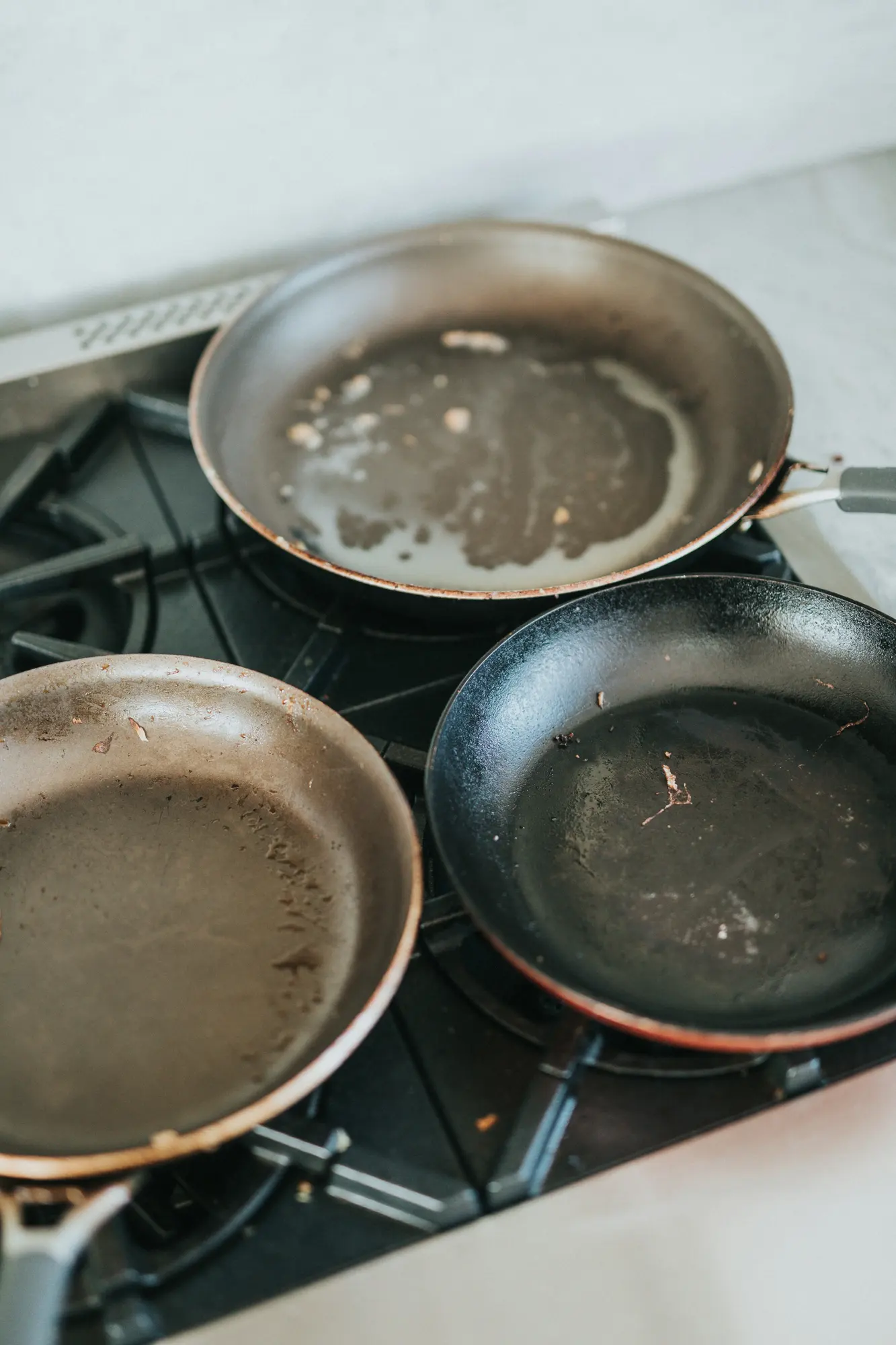
A nonstick coating is a thin layer of PTFE, or of a ceramic material, bonded to a metal body. Its whole value is in its surface, and anything that roughens that surface makes food stick: scratches from metal tools and scourers, abrasion from stacking, residues baked on by high heat, and repeated overheating, which can damage the coating itself. Once food starts to stick, cooks add more fat and turn the heat up, and the decline speeds up.
If you are wondering whether PTFE itself is safe, our article on PTFE, PFOA and PFAS goes through what the food agencies say. The short version is that used as intended it is not expected to harm health, and the one real hazard is overheating1.
Before the first use
Most coated pans need a wash before you cook in them. Germany's Federal Institute for Risk Assessment (BfR) recommends treating coated cookware before first use according to the manufacturer's instructions1. Usually that means washing it in warm soapy water, drying it, and sometimes wiping a few drops of oil over the surface. Keep the leaflet, or photograph it: it also tells you the maximum oven temperature and whether the dishwasher is allowed.
Heat: the rule that matters most
Nonstick pans are made for low and medium heat. That is enough for eggs, pancakes, fish and most vegetables, and it is where the coating lasts longest.
The rule that matters for safety is simple: never heat a nonstick pan empty. PTFE begins to decompose at around 360 °C, releasing gases that are hazardous to health, without visible smoke1. With food in the pan the temperature stays close to 100 °C while there is water present, and oil starts to smoke between 110 and 270 °C, which gives you a warning1. An empty pan has neither brake. The BfR specifically warns about induction hobs and gas, because they heat very fast1, and advises against using PTFE pans directly over flames, for example on a barbecue1.
Breathing those fumes causes polymer fume fever, a flu-like illness that usually passes on its own but can be serious for people with heart or lung disease; overheated nonstick cookware is one of the more common ways people are exposed2. Birds are far more vulnerable than people, and pet birds have died after a PTFE pan was overheated3. If you keep birds, keep them out of the kitchen.
In practice:
- Put the food or the fat in the pan before you turn on the heat, or within seconds of it.
- Use medium heat as your maximum. If you want a hard sear, use steel or cast iron instead.
- Do not walk away from a nonstick pan on a high flame.
Fat, tools and what to cook
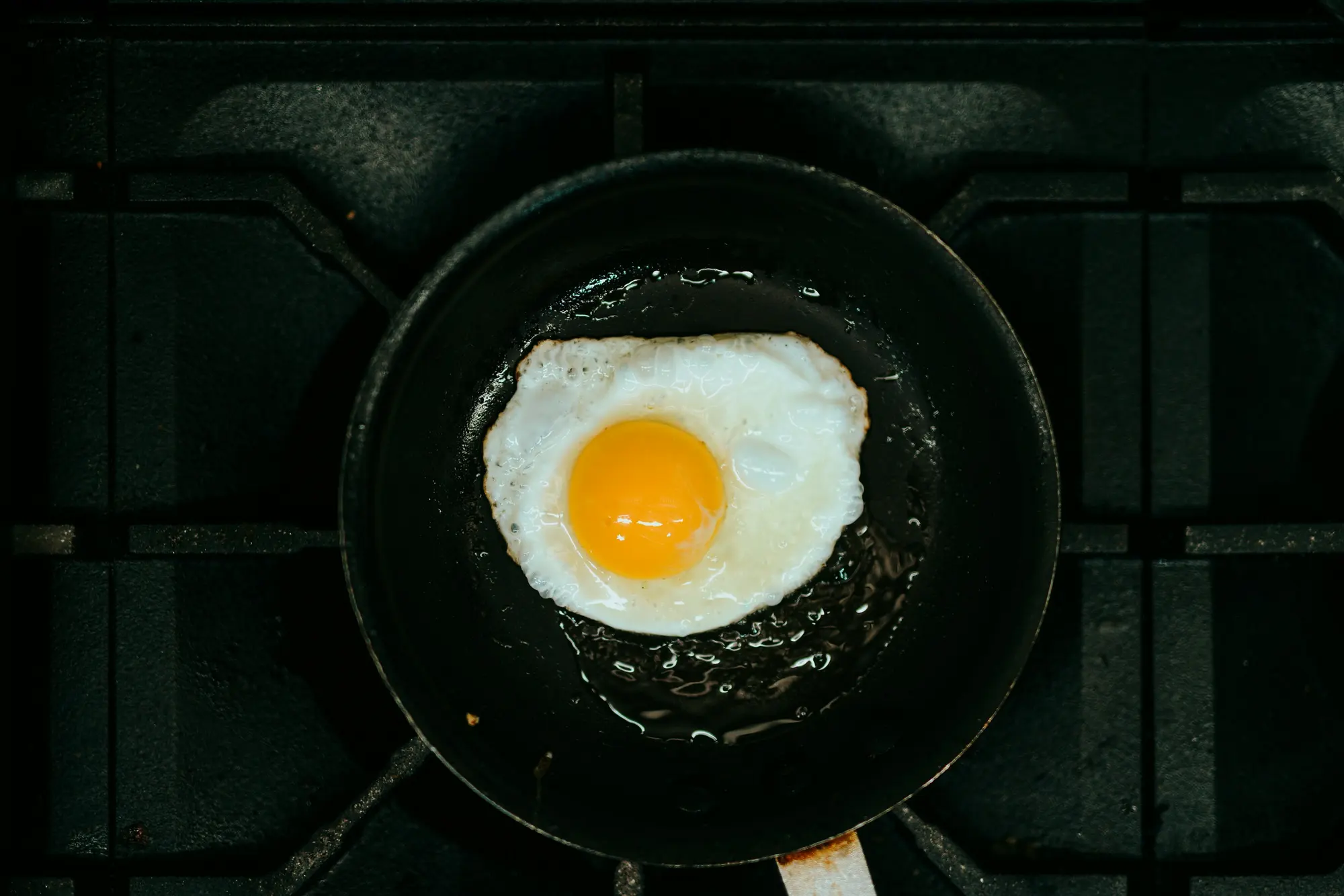
A little fat helps. Even on nonstick, a teaspoon of oil or a knob of butter improves browning and protects the surface. Aerosol cooking sprays are best avoided on nonstick: they tend to leave a thin film that bakes on at the edges and slowly builds up into a sticky layer.
Use soft tools. Wooden spoons, silicone spatulas and nylon turners. Metal tools, whisks and forks scratch. A 2022 laboratory study estimated that a scratched nonstick surface might release thousands to millions of tiny PTFE particles during a simulated cooking process4. The BfR's view is that swallowed PTFE particles pass through the body unchanged1, but scratches are also what end the life of the pan, so there are two good reasons to keep metal out of it.
Do not cut in the pan. Slice the omelette on a board.
Give it the right jobs. Keep nonstick for eggs, crêpes, pancakes, delicate fish and reheating. Use a steel or cast iron pan for searing meat, reducing sauces hard and anything that goes in a very hot oven; our comparison of pans sets out which job suits which.
Washing and storing
- Let it cool first. Plunging a hot pan into cold water can warp the base, and a warped pan heats unevenly.
- Wash by hand with warm soapy water and a soft sponge or cloth. Avoid scouring pads, steel wool and abrasive powders.
- Soak stubborn residue in warm soapy water for a few minutes instead of scrubbing.
- Dry it and store it so nothing rubs the cooking surface. If you stack pans, put a cloth, a paper towel or a felt pan protector between them, or hang them.
Ceramic coatings are different
Pans sold as ceramic nonstick use a coating made by a sol-gel process rather than PTFE. GreenPan, for example, describes its Thermolon coating as based on a derivative of sand, sprayed on as a solution, and states that it contains no PFAS, lead or cadmium5. The maker also says the coating withstands temperatures as high as 450 °C and will not blister or release toxic fumes if accidentally overheated5. Those are manufacturer claims, not independent assessments, but they make ceramic a reasonable choice if you want to avoid PFAS altogether.
The care is largely the same: gentle heat, soft tools, hand washing and no aerosol sprays. GreenPan's own advice is to wipe the pan clean with a soft cloth and soapy water rather than scrub it5.
When to replace the pan
Replace a nonstick pan when:
- eggs stick even with a little fat at medium heat;
- the coating is flaking, blistered or worn through to metal in places;
- there are deep scratches across the cooking surface;
- the base has warped and the pan rocks on the hob.
Replacing it at that point is not a health emergency. It is simply that a pan that no longer releases food is no longer doing the one job you bought it for. Look after the next one with gentle heat and soft tools, and it will last a great deal longer.
Questions
How long should a nonstick pan last?
It depends on use and care more than price. A pan used daily at high heat with metal tools may be finished within a year; one kept for eggs and fish at gentle heat, washed by hand, can go on for several years. Replace it when it stops releasing food.
Can I put a nonstick pan in the dishwasher?
Check what the maker says. Even where it is allowed, hand washing with a soft sponge is gentler on the coating, and it takes less than a minute.
Is it dangerous to cook in a scratched nonstick pan?
Germany's Federal Institute for Risk Assessment says swallowed flakes of PTFE pass through the body unchanged and are not expected to harm health. A badly scratched pan is still worth replacing, because it sheds particles and no longer works well.
Can I use a nonstick pan in the oven?
Only if the maker says so, and only up to the temperature they give, which often depends on the handle. A domestic oven tops out around 250 °C, well below the point at which PTFE breaks down.
Sources
Numbered in the order the article cites them. Opened and read on the date shown.
- Selected questions and answers on cookware, ovenware and frying pans with a non-stick coating made of PTFE German Federal Institute for Risk Assessment (BfR), 2025-07-02. Read Thursday, 22 October 2026.
- Metal fume fever and polymer fume fever (Clin Toxicol 2015;53(4):195-203) Greenberg MI, Vearrier D, 2015. Read Thursday, 22 October 2026.
- Fatal toxicosis in pet birds caused by an overheated cooking pan lined with polytetrafluoroethylene (J Am Vet Med Assoc 1983;182(11):1248-1250) Wells RE, 1983. Read Thursday, 22 October 2026.
- Raman imaging for the identification of Teflon microplastics and nanoplastics released from non-stick cookware (Sci Total Environ 2022;851:158293) Luo Y, Gibson CT, Chuah C, Tang Y, Naidu R, Fang C, 2022. Read Thursday, 22 October 2026.
- Thermolon: our healthy ceramic non-stick coating GreenPan (manufacturer). Read Thursday, 22 October 2026.
How we write and check: our method. Spotted an error? Tell the editor.